What Google and the FTC ban when you ask for reviews: a 2026 checklist for contractors
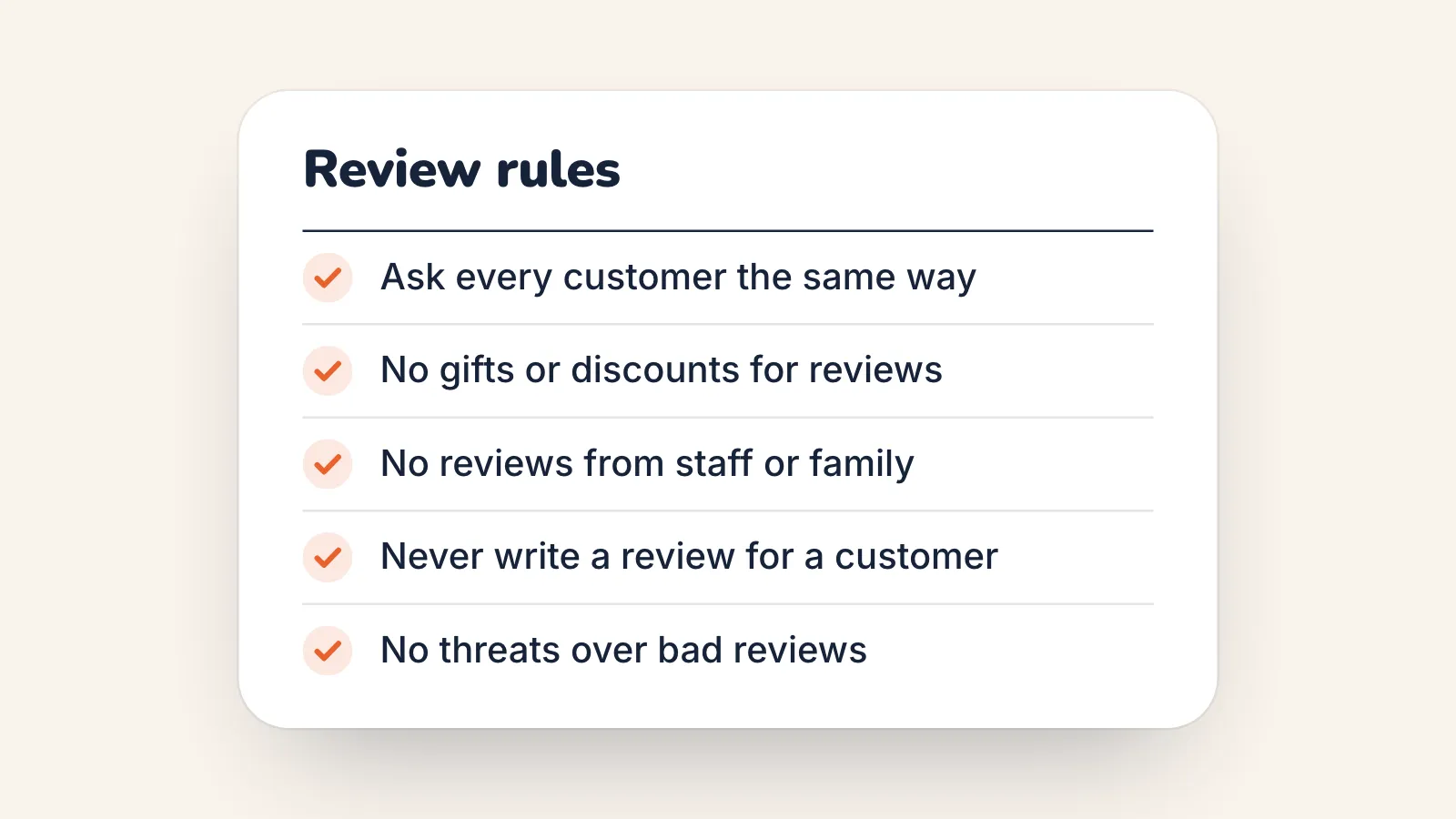
Ask every customer the same way, never reward anyone for a review, never write or post reviews yourself or through your staff or family, and never pressure anyone to change or remove a bad one. Google bans asking only happy customers and any kind of review incentive. The FTC's rule on consumer reviews, in force since October 21, 2024, bans fake reviews, rewards tied to positive reviews, hidden insider reviews and threats over bad ones, with penalties of up to $53,088 per violation.
This page is a plain-English summary for owners, not legal advice. It covers both sets of rules in one checklist, the traps owners fall into, and what enforcement looks like now.
The checklist
| Rule | FTC | On the job, that means | |
|---|---|---|---|
| Ask every customer | Banned: selectively soliciting positive reviews | Every finished job gets the same review text | |
| No rewards for reviews | Banned: any incentive | Banned: rewards tied to a positive or negative review | No discount, gift card or raffle entry for a review |
| No reviews from your people | Banned: conflict of interest (staff, family, competitors) | Insider reviews must disclose the connection | Your crew, your spouse and your cousin don't review you |
| No fake reviews | Banned | Banned, including buying them | Nobody writes a review for a customer, including you |
| No threats over bad reviews | Banned: threats or intimidation to get a review removed | You can reply and report; you can't threaten | |
| No hiding bad reviews | Banned: suppressing negative reviews while implying you show them all | A testimonials page can't quietly drop every complaint and call itself "all our reviews" | |
| No staff review quotas | Banned | Don't make reviews part of a tech's targets | |
| No fake followers | Banned: buying fake followers or views | No bought likes or follower counts |
Sources: Google's review policy and the FTC's rule on consumer reviews and testimonials.
Review gating: the rule owners break without knowing it
Gating means asking only the customers you expect to leave a good review. It's banned by Google, and it shows up in ways that don't feel like cheating:
- Only texting the customers who seemed happy at the end of the job.
- A "how did we do?" survey that sends 5-star answers to Google and everyone else to a private form.
- Skipping the job that went sideways, even after you fixed it.
The fix is simple: every customer gets the same ask, and a job with a problem gets it once the problem is fixed.
Incentives: where Google is stricter than the FTC
The FTC rule bans rewards that depend on the review being positive or negative. Google goes further and bans rewards of any kind, even for an honest review. Since Google's rules decide what stays on your Business Profile, follow Google's:
- No "$10 off your next service for a review."
- No raffle or drawing for people who leave one.
- No free gutter cleaning, car wash or add-on in exchange.
Thanking someone after they leave a review is fine. Paying them for it isn't.
Your crew, your family and your friends
Reviews from people with a stake in your business break Google's conflict-of-interest rule, even when everything they write is true. That includes employees, family members and close friends who never hired you. Under the FTC rule, a review from an insider has to disclose the connection, and on Google it shouldn't be posted at all.
A good rule for a small crew: if they'd get a paycheck, a dinner invitation or a holiday card from you, they don't review you.
Fake reviews, whoever writes them
A review the customer didn't write is a fake review. That covers a review you write and post under a customer's name, one a marketing vendor writes for you, and one you write for a customer to "just copy and paste." The FTC rule bans fake reviews and buying them (eCFR).
Helping a customer find the review box is fine. Writing the review for them isn't.
What you can and can't do about a bad review
You can reply calmly, take it offline, fix the problem, and report a review that breaks Google's policies. You can't threaten the customer, demand they remove it, or offer them something to change it. The FTC rule specifically bans using threats or intimidation to get a review taken down. For example replies, see how to reply to a bad Google review.
What enforcement looks like now
- Warning letters. On December 22, 2025 the FTC sent warning letters to ten companies, including property managers offering lease discounts or gift cards for positive reviews (FTC).
- A settlement. In 2026 a vitamin company settled over reviews written by its own employees posing as customers and reviews from people who got free product or a discount for five stars. The order included a $4 million judgment, partly suspended after a $750,000 payment (DLA Piper summary).
- A lawsuit against a home repair company. In May 2026 the FTC and the Illinois Attorney General sued a home repair services company, alleging it had employees, relatives and SEO companies post fake five-star reviews. The case is pending and the company has moved to dismiss it, so these are allegations, not findings (same source).
- Penalties. Up to $53,088 per violation under the rule.
The home repair case is the one to notice. It's the kind of shortcut a busy owner or an eager marketing vendor might take without thinking of it as fraud.
Texting customers for reviews: what applies
- Texting from your own phone. Person-to-person texts sent by hand from your phone don't need carrier registration (Telnyx on 10DLC).
- Texting through software. Texts sent through a texting platform from a business number need 10DLC registration, and carriers block unregistered traffic.
- Stop means stop. If a customer asks you to stop texting, stop, and don't add them to any list.
- Bulk sends are different. Texting a big list of past customers through software brings in consent rules. Talk to a lawyer before you do that.
A review routine that stays inside the rules
- Tell every customer at the door that you'll text them a link.
- Send the same review text to every customer once the job is done and paid for (templates).
- Send one reminder about three days later to anyone who hasn't left one (reminder texts).
- Reply to every review, good and bad (5-star replies).
- Report reviews that break Google's policies.
- Never offer anything for a review, and never let your people review you.
How Compa follows these rules
Here's a sample from the site: an owner asks for a review request after a roof job in Babylon, and Compa sends back the text to forward.
Every customer gets asked the same way. Compa writes the ask, never the review.
Compa writes the review ask, never the review. Every customer gets asked the same way, and you send the text from your own phone, so Compa never texts your customers.
Common questions
Can I give a gift card to customers who leave a review?
No. Google bans review incentives of any kind, even for honest reviews.
Can I ask only my best customers for reviews?
No. That's review gating, and Google bans it. Ask every customer the same way.
Can my employees leave reviews for my business?
No. Reviews from employees, family and anyone with a stake in the business break Google's conflict-of-interest rule.
Is it OK to remind a customer about a review?
Yes. One friendly reminder to every customer who hasn't left one is fine. The rules are about who you ask and what you offer.
Can I offer a discount in my reply to a review?
Google's guidance on replies says to leave promotions out (Google's tips).
Is this legal advice?
No. It's a plain-English summary of Google's policies and the FTC rule as of November 2026. For anything unusual, like texting a large list or a review dispute with a lawyer involved, talk to a lawyer.
Get the same review ask written for every customer
Compa's beta is open to Long Island owners first. Text a photo after the job and Compa writes the review text for that customer, the same way every time, for you to send from your phone.
Text COMPA to (516) 452-8282 to get started. By texting COMPA, you agree to receive automated text messages from Famedia LLC, the company behind Compa, including replies about the photos, reviews and questions you send and, only if you reply YES, check-ins and a Monday recap. Your consent is for Famedia LLC only and is never shared with other companies. Message frequency varies. Message and data rates may apply. Reply HELP for help or STOP to cancel. Privacy Policy | Terms of Service
Sources
- Google: Maps user contributed content policy
- eCFR: 16 CFR Part 465, Use of Consumer Reviews and Testimonials
- FTC: Warning letters to ten businesses on the consumer review rule
- DLA Piper: The FTC's 2026 enforcement approach to fake reviews
- Telnyx: What is 10DLC
- Google Business Profile Help: Tips to manage reviews
Compa is built by Michael Famiglietti, who spent two years as the in-house marketing department for a home service company on Long Island.
Why Michael built Compa